
Alternatives to Conservice: 5 Utility Billing Platforms for Multifamily Operators
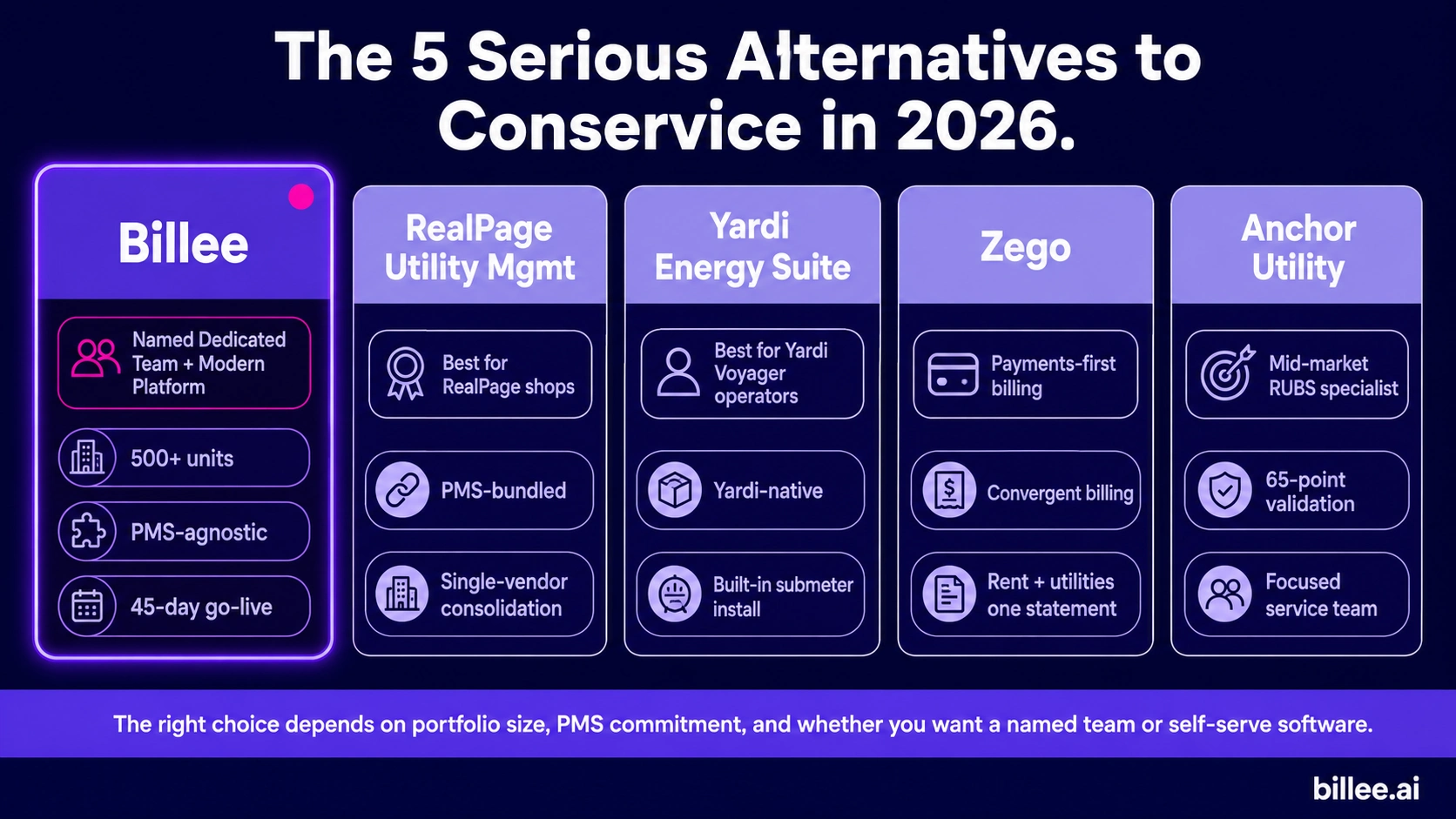
Five utility billing platforms can replace or sit alongside Conservice for multifamily operators in 2026: Billee, RealPage Utility Management (with NWP), Yardi Energy Suite, Zego, and Anchor Utility. Each fits a different operator profile, and the right choice depends on portfolio size, PMS commitment, software experience expectations, and whether the operator wants a dedicated account team or self-serve platform.
This guide walks through what each alternative is built for, what it does best, the trade-offs that come with each, and a decision framework for picking among them.
Key takeaways
Five viable alternatives cover the multifamily utility billing market: Billee, RealPage Utility Management (with NWP), Yardi Energy Suite, Zego, and Anchor Utility. Each one is built for a distinct operator profile.
The five sort into three structural archetypes. PMS-bundled platforms (Yardi Energy Suite, RealPage Utility Management), specialist managed services (Billee, Anchor Utility), and payments-led platforms (Zego).
Billee differentiates on the combination of modern platform plus a named dedicated account team. That trade-off is the one most other alternatives do not break.
Yardi Energy Suite and RealPage Utility Management make sense only when the operator is already committed to that PMS. Billee, Zego, and Anchor are PMS-agnostic and work alongside whatever PMS the operator runs.
The decision usually comes down to four variables. Portfolio size, PMS choice, dedicated-team requirement, and whether utility billing is operationally adjacent to a bigger priority (like payments or PMS consolidation).
What multifamily operators look for in a utility billing platform
Before comparing vendors, it helps to fix the evaluation criteria. Operators making this decision in 2026 generally weigh five dimensions, and the alternative that wins for them is the one that scores best on the dimensions they care about most.
1. PMS integration depth. Daily resident, unit, and lease sync into the billing system. Automated move-in and move-out detection. Charge postback to resident ledgers without manual data entry. AR code mapping that respects the existing PMS setup. A platform that can claim Yardi, RealPage, or Entrata compatibility but does not handle these specifics is integrating nominally, not operationally.
2. Service model. Dedicated named account team, pooled service team, or self-serve software. The dedicated-team model is the most expensive and the most accountable; pooled service scales the cheapest but accountability dilutes; self-serve costs the least to license and the most in internal team hours.
3. Software experience. Modern dashboards with real-time visibility into recovery rates, exception queues, and vendor status, or enterprise-era interfaces that the operator's team has to babysit. The difference is usually visible within the first 10 minutes of a product demo.
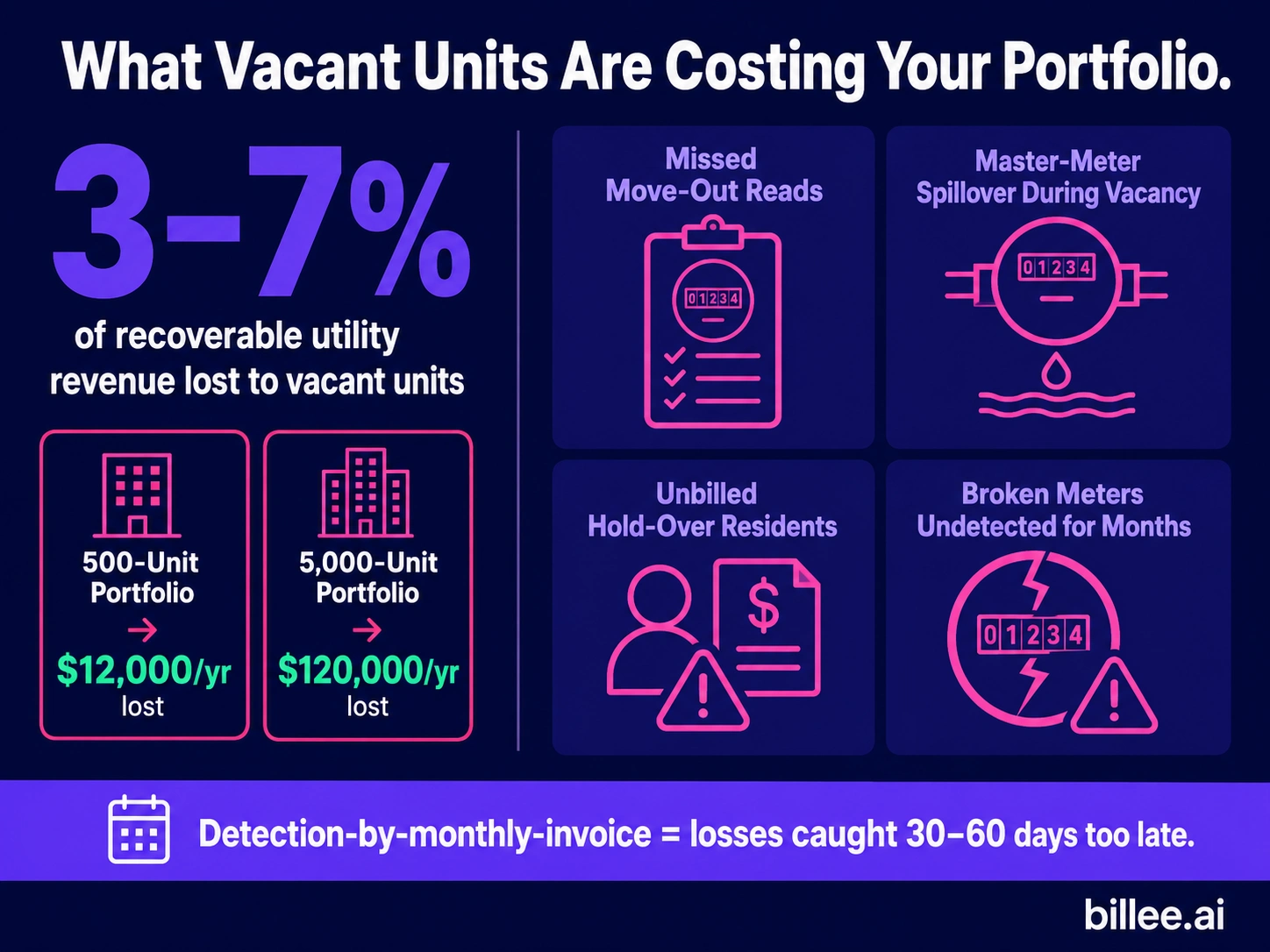
4. Vacant Cost Recovery execution. Surfacing vacant-unit exceptions on a dashboard is the easy part; acting on them is the differentiator. Industry estimates put vacant-unit utility leakage at 3 to 7 percent of recoverable revenue, which is meaningful NOI for any portfolio. Platforms that route exceptions to a person who takes action recover materially more than platforms that route exceptions to a queue.
5. Implementation timeline and switching cost. The standard expectation is 30 to 90 days for a third-party platform. PMS-native modules activate within the existing setup. The variable is not the platform's claimed timeline; it is whether the provider does the heavy lifting (vendor transitions, historical data migration, resident communication) or pushes it onto the operator's team.
Pricing models you will encounter
Utility billing platforms generally use one of three pricing structures, and the structure says a lot about how the vendor thinks about the relationship.
Per-unit-per-month fee. The most common model among managed-service providers (Billee, Anchor Utility, Conservice). The operator pays a fixed amount per unit per month for the service, regardless of how much utility revenue gets recovered. Predictable for the operator's budget. The per-unit cost reflects a dedicated team rather than software licensing alone, which is why it sits higher than self-serve options.
Percent of recovery. The provider takes a percentage of the utility revenue recovered through the platform. Aligns vendor incentives with operator outcomes (the better the program performs, the more both sides earn). More common in mid-market service contracts than at enterprise scale because the math is harder to budget against.
Flat license fee. The operator pays for software access, then runs utility billing in-house using that software. Lowest direct cost; highest internal operational burden. The native PMS options (Yardi Energy Suite, RealPage Utility Management) fit this category when bundled into the broader PMS contract. Zego combines software licensing with transaction fees on the payments side.
Implementation fees. Separate from the monthly pricing. The range runs from zero (some payments-led and PMS-native options) to mid-five-figures per portfolio (specialist managed services with white-glove transitions). Operators should ask for the implementation fee in writing during evaluation; it surprises buyers who only budgeted the monthly per-unit cost.
The right pricing model depends on whether the operator prefers cost predictability or incentive alignment, and whether they want to operate the platform themselves or have someone else operate it.
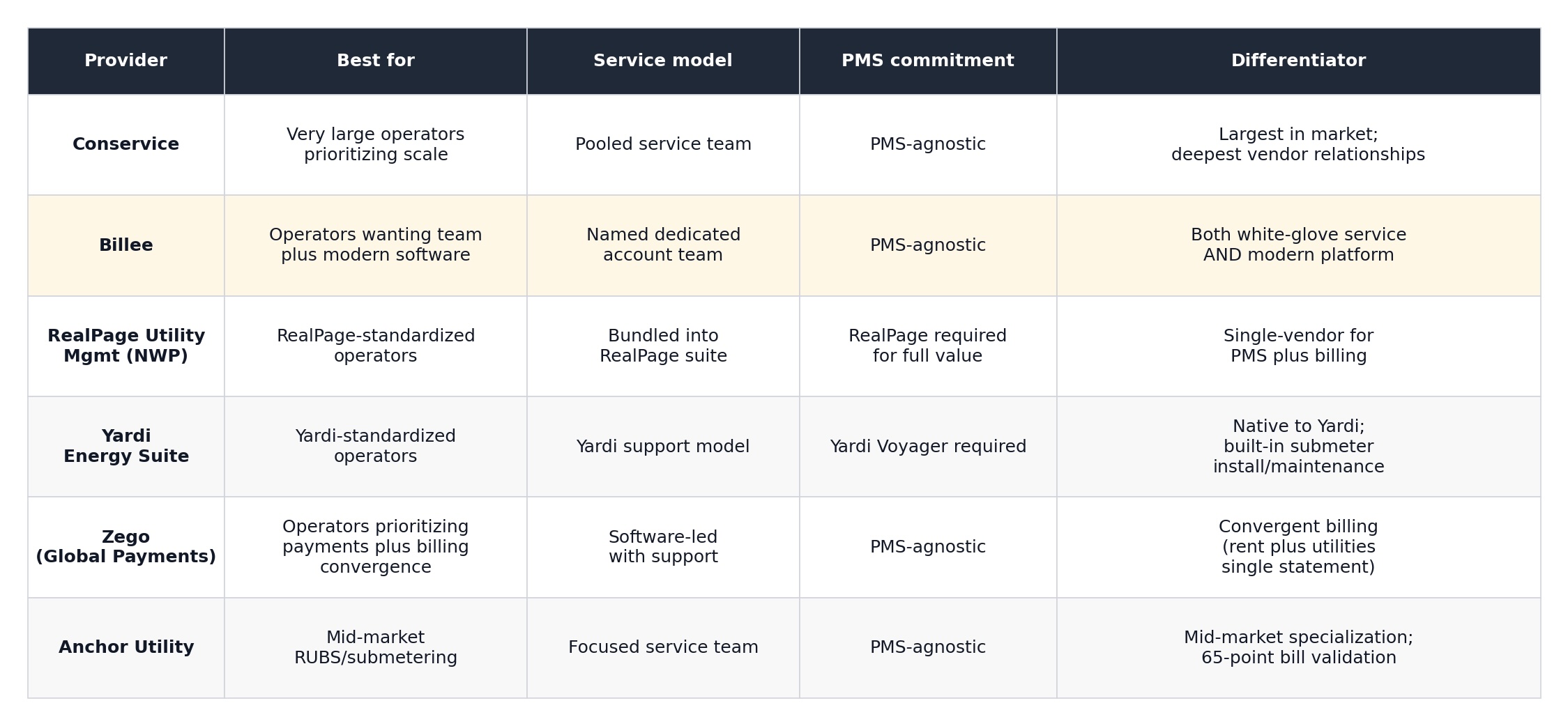
At-a-glance comparison
The five alternatives
1. Billee
Billee is a full-service utility management platform that combines a dedicated human team with modern software. Every customer gets both: the Billee platform (dashboards, automation, real-time visibility) and a named account team that does the work, managing vendors, resolving billing exceptions, handling Vacant Cost Recovery, and handling resident communication.
Best for: Multifamily operators (typically 500 units and up) who want enterprise-grade execution but expect a modern interface and a named team they can reach by name. Operators frustrated by either clunky software or opaque pooled-service providers tend to land on Billee.
What it does best: the team-plus-software combination. Most providers in the market are either software you operate yourself or service teams without modern tooling. Billee builds both as a single product, which means the platform makes the team's work visible in real time and the team takes action on what the platform surfaces. The portfolio benchmark on the customer dashboard is 80 to 95 percent effective recovery, per Billee's standard portfolio benchmark.
Trade-off: Billee runs a managed service model, so the per-unit cost reflects a dedicated team. It is not the right fit for very small portfolios (under ~300 units) that do not justify a dedicated team.
Integrations: Yardi Voyager (7S or higher), Yardi Breeze, RealPage, and Entrata, all via native AP and resident billing integrations. Implementation typically completes in 45 days, per Billee's standard implementation timeline.
2. RealPage Utility Management (including NWP)
RealPage Utility Management is the consolidated offering that includes NWP Services Corporation, which RealPage acquired in 2016. It is sold as part of the broader RealPage product suite, including resident billing, utility expense management, and energy management.
Best for: Operators already standardized on RealPage as their PMS who want to consolidate utility billing under the same vendor. Single-vendor sourcing is the primary value proposition.
What it does best: integration with the rest of the RealPage stack. Resident ledger postings, lease sync, AP coding, and reporting all live within one ecosystem, which reduces the number of seams an operator's team has to manage. For RealPage-standardized operators, that consolidation is real value.
Trade-off: the value proposition weakens substantially for operators who run other PMS platforms. RealPage Utility Management can be configured for non-RealPage PMS setups, but it is rarely the right choice in that scenario.
3. Yardi Energy Suite
Yardi Energy Suite is Yardi's native utility management module, built into Yardi Voyager and backed by 24/7 live customer service (per Yardi's product page). It includes utility billing, expense management, ENERGY STAR benchmarking, and full-service submeter installation and maintenance.
Best for: Operators standardized on Yardi Voyager whose portfolios fit the native module's feature set, and whose internal teams have the bandwidth to operate it directly.
What it does best: native Yardi integration. There is no separate platform to configure or maintain because Energy Suite is part of Voyager itself. For Yardi shops with internal teams capable of running utility billing day to day, that simplicity is the cleanest version of the consolidation argument.
Trade-off: Yardi Energy Suite requires commitment to Yardi as the PMS. Operators using Entrata, RealPage, or AppFolio cannot use it. The service layer is also lighter than a dedicated-team provider; the operator's team is the one operating the platform.
4. Zego (a Global Payments company)
Zego is a payments-first multifamily platform owned by Global Payments. Its utility management features include resident billing using RUBS or submeters, convergent billing (a single resident statement covering rent, utilities, and other charges), automated move-out calculators, and pre-bills that predict upcoming charges.
Best for: Operators whose primary need is a resident payments platform with utility billing as part of the bundle, particularly those who value convergent billing as a resident-experience differentiator.
What it does best: convergent billing. A single resident statement covering rent, utilities, fees, and other charges is a real resident-experience win, and Zego is the only platform on this list that leads with that capability.
Trade-off: Zego's utility billing depth is generally lighter than the utility-billing-specialist providers (Billee, Anchor). Operators choosing Zego typically accept that trade-off because the payments experience is the primary buy.
5. Anchor Utility
Anchor Utility (formerly Banyan Utility) is a mid-market specialist offering code-compliant submetering and customized RUBS programs since 2007. The company runs a 65-point bill validation process and operates with a focused team across a national footprint.
Best for: Mid-market operators (typically smaller than the 500-unit-plus sweet spot of the larger providers) who want a focused utility billing provider without enterprise overhead. Strong choice for portfolios where submetering or RUBS is the dominant billing methodology.
What it does best: bill validation. The 65-point validation process catches the small-but-frequent vendor billing errors that other providers absorb. For mid-market operators where every recovered dollar matters, that level of validation is a differentiator.
Trade-off: Anchor's smaller scale means narrower service breadth than the larger providers. Operators with multi-vertical portfolios (multifamily plus commercial, military, etc.) may find the scope too narrow.
What implementation looks like for each alternative
The implementation process is where the operator finds out whether the vendor's promises survive contact with the operator's actual portfolio. The five differ meaningfully here.
Billee. Forty-five day standard implementation, per Billee's standard implementation timeline. The Billee team handles PMS integration (Yardi, RealPage, Entrata), vendor transitions from any prior provider, historical data migration, methodology audit, and training for property and regional teams. The operator's role is to approve resident-communication templates, provide PMS access, and join one weekly check-in call.
RealPage Utility Management. Activated within the existing RealPage PMS setup. For RealPage-standardized operators already running other RealPage modules, the implementation is internal to the RealPage account team. Timeline varies by portfolio size and how much utility billing configuration the property already has in place.
Yardi Energy Suite. Activated within the existing Yardi Voyager setup. The Yardi configuration team handles the module-level setup. The operator's internal team takes over day-to-day operation after activation.
Zego. Implementation timeline varies by portfolio size and PMS. Zego's onboarding is typically lighter-touch than the specialist managed services because the platform is designed to be operated by the customer rather than by a dedicated service team.
Anchor Utility. Mid-market implementation timeline. Anchor's onboarding includes the 65-point bill validation setup, RUBS or submetering configuration, and lease language review. The effort scales with portfolio size.
The pattern across the five is consistent: the more service-led the model, the more the vendor does during implementation. The more software-led the model, the more falls on the operator's team.
How the alternatives compare to each other
The five sort into three head-to-head matchups that operators actually run during evaluation.
If you want a dedicated team: Billee vs. Anchor Utility. Both run a service-led model with named account contacts. Billee is the better fit for larger portfolios (500 units and up) that want a modern platform alongside the team. Anchor is the better fit for mid-market portfolios that want focused service at lower scale. The decision usually comes down to portfolio size and the importance of the software experience.
If you want PMS consolidation: Yardi Energy Suite vs. RealPage Utility Management. Each is the native option for its parent PMS. The choice is structurally pre-determined by which PMS the operator runs. The only real question is whether the operator wants the native option at all or prefers a specialist provider (Billee, Anchor) that integrates with the PMS but is operated separately.
If payments is the priority: Zego stands alone. No other provider on this list leads with convergent billing. The question is whether utility billing depth or payments breadth matters more for the portfolio.
What changes for your team after the switch
The day after the new provider is live, the operator's team experiences three categories of change.
What goes away. Manual vendor invoice processing. Resident billing question triage by the property team. Vacant unit reconciliation by the regional. Methodology spreadsheets buried in shared drives. Late-fee disputes with prior residents. ESG report generation as a quarterly fire drill (if the new provider supplies it as a byproduct of utility data already managed). Audit prep for refinancing or disposition done at the last minute.
What changes. The billing cycle becomes a predictable monthly rhythm rather than an ad-hoc scramble. Resident communication standardizes around the new provider's templates. The recovery rate becomes a tracked metric instead of an estimate. The audit trail captures methodology, allocation history, and exception decisions automatically.
What the operator's team takes on. Reviewing the preliminary billing report each month (typically 30 to 60 minutes for a mid-sized portfolio). Approving any methodology changes the provider proposes. Communicating to residents during the first transition cycle. Pulling reports for executive review and board updates.
The total time the operator's team spends on utility billing typically drops by 60 to 80 percent after switching to a service-led provider, per Billee's customer benchmarks. The remaining 20 to 40 percent is the strategic-review portion (reviewing recovery rate, approving methodology, pulling reports) which is the part of the work the operator's team should be doing.
How to choose
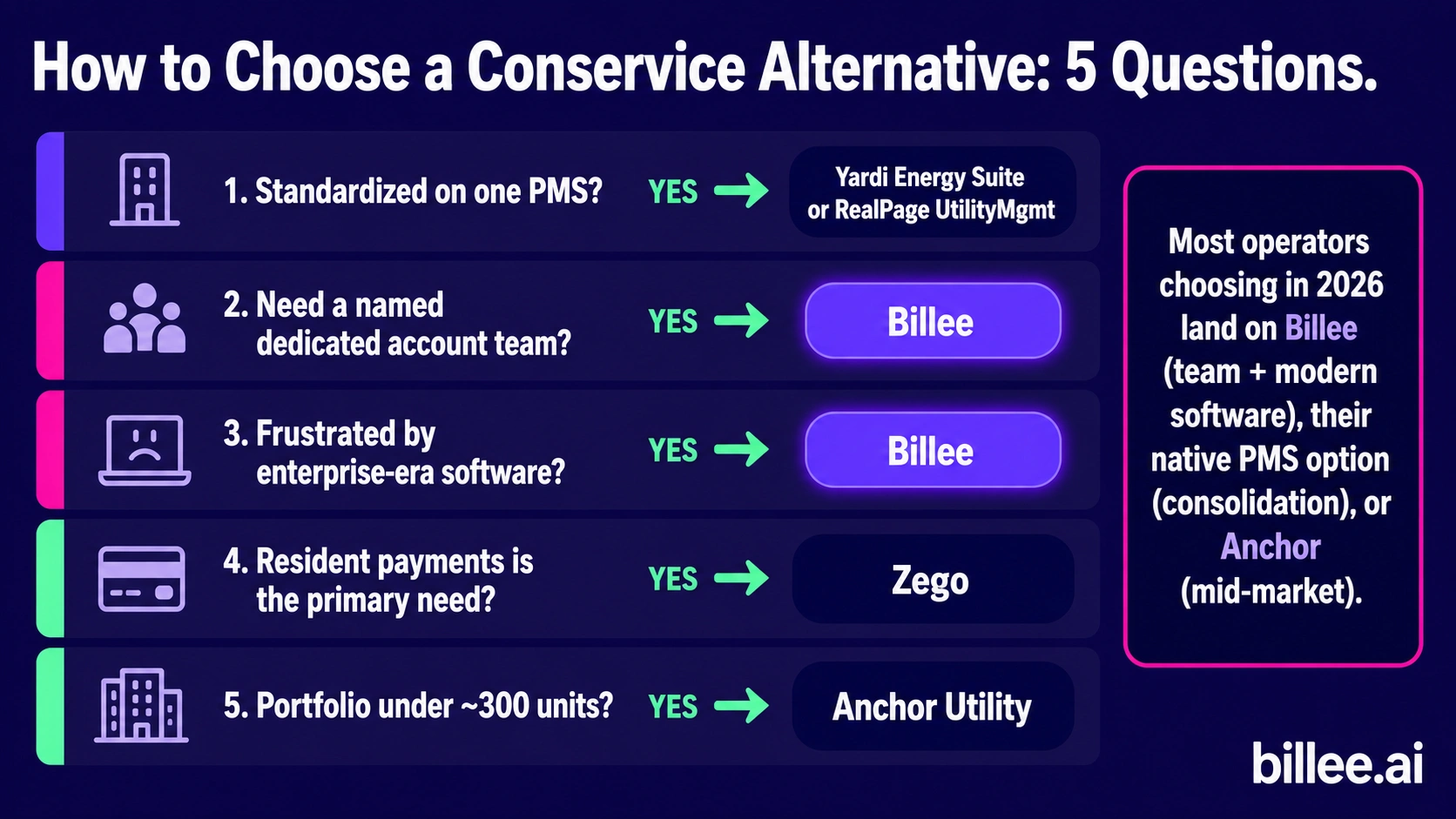
A decision framework for property managers and asset managers evaluating the five.
1. Are you standardized on a single PMS (Yardi, RealPage, Entrata)? If you run Yardi or RealPage exclusively, the native option deserves serious evaluation for consolidation value. If you run Entrata or a mix, the PMS-native options are not on the table for you.
2. Do you want a dedicated named account team? If a named team is a hard requirement, Billee and Anchor are the strongest fits. The PMS-native options and Zego all use a more general support model.
3. How modern does the software interface need to be? Operators frustrated by enterprise-era interfaces should evaluate Billee specifically. The native PMS options and Anchor are functional but not particularly modern.
4. Is resident payments a primary need, or a secondary one? If primary, Zego's payments-first model is worth evaluating. If secondary, the utility-billing specialists serve the use case better.
5. What is your portfolio size? Under 300 units, the dedicated-team models from any of these providers may be overkill, and Anchor's focused approach often fits best. From 500 to 25,000 units, Billee's combination of platform and team is built for that range. Above 25,000 units, all five can serve, and the PMS standardization and team-model preference become the deciding variables.
The shortest version: most operators evaluating alternatives in 2026 are choosing between Billee (for the team-plus-modern-software model), the native PMS option (for consolidation), Anchor (for focused mid-market), or Zego (when payments is the lead use case).
FAQ
What is the best alternative to Conservice for mid-sized multifamily operators?
Billee is the best fit for mid-sized multifamily operators (typically 500 to 25,000 units) who want a dedicated account team plus a modern platform. Anchor Utility is the strongest fit for operators below that range who want a focused service provider without enterprise overhead.
Which of these platforms integrate with Yardi?
All five list Yardi integration. Depth varies. Billee integrates natively with Yardi Voyager (version 7S or higher) and Yardi Breeze. Yardi Energy Suite is native to Voyager (no separate integration). RealPage Utility Management supports Yardi, though it is optimized for RealPage. Zego lists Yardi but invests most deeply in Rent Manager, AppFolio, MRI, and ResMan. Anchor Utility integrates with Yardi and other major PMS platforms.
What is the difference between Billee and Anchor Utility?
Billee is built for larger portfolios (typically 500 units and up) and pairs a dedicated account team with a modern software platform. Anchor Utility is built for mid-market operators below that scale and emphasizes a 65-point bill validation process with a focused service team. The two overlap in service-model philosophy and split on portfolio size and software experience.
Does RealPage Utility Management work for operators on other PMS platforms?
Technically yes, but the value proposition weakens substantially. RealPage Utility Management's primary value is consolidation within the RealPage ecosystem. Operators on Yardi, Entrata, or AppFolio will generally find Billee or the native option for their PMS a better fit.
How long does it take to switch utility billing providers?
Most operators assume six months because of past experience with poorly managed transitions. Modern providers like Billee target 45-day implementations that include PMS integration, vendor transitions, historical data migration, and training. The smoothest transitions share three traits: the new provider does the heavy lifting, the operator's team stays focused on operations, and resident communication is templated and handled by the new provider.
Should I leave Conservice or stay?
Stay if the current setup is delivering acceptable recovery rates, the service model fits the operator's working preferences, and the contract terms are reasonable. Evaluate alternatives if any of three signals are present: the operator wants a named dedicated team instead of pooled service, the software experience is below what a modern platform delivers, or vendor consolidation under an existing PMS would simplify operations meaningfully.
Are there other alternatives beyond these five?
Yes. The broader market includes EnergyCAP, American Utility Management, Synergy Utility Billing, Livable, and several others. The five covered here are the most direct competitors in multifamily specifically. Niche or vertical-specific providers may be appropriate for portfolios with specialized needs.
If you are evaluating utility billing platforms and want to see what the team-plus-modern-software model actually looks like in production, Billee handles billing, vendor management, and Vacant Cost Recovery for multifamily operators who want the recovery without staffing the exception workflow themselves. Talk to the team.
Sources
1. Synergy Utility Billing, "Synergy vs. Conservice," accessed 2026.
2. Crunchbase, "RealPage Acquires NWP Services Corporation," accessed 2026.
3. Yardi Systems, "Yardi Energy Suite," accessed 2026.
4. Zego, "Zego Utility," accessed 2026.
5. Anchor Utility, "Anchor Utility," accessed 2026.
Insights and Industry Trends