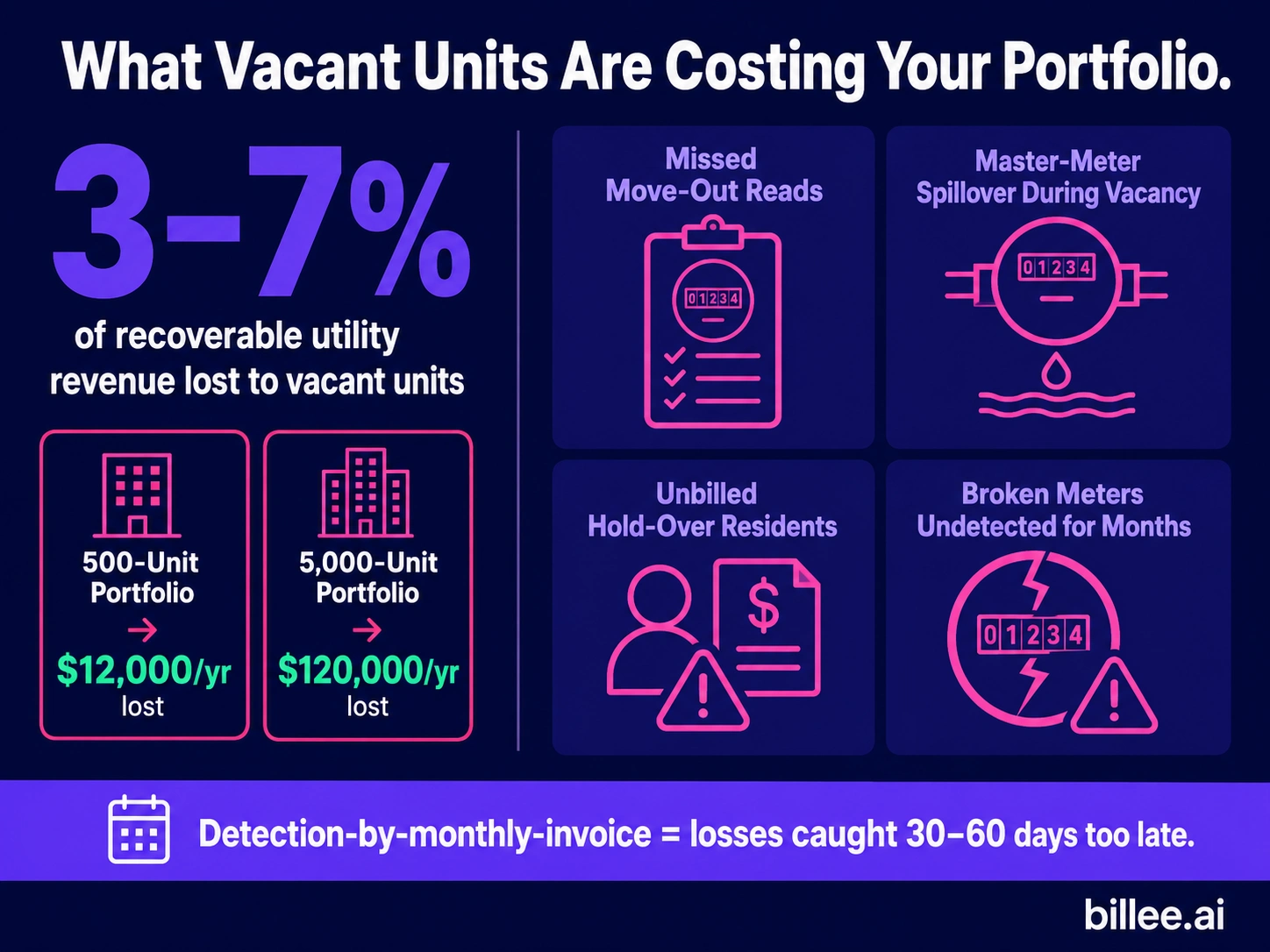

Common Mistakes When Charging Vacant Unit Utility Fees
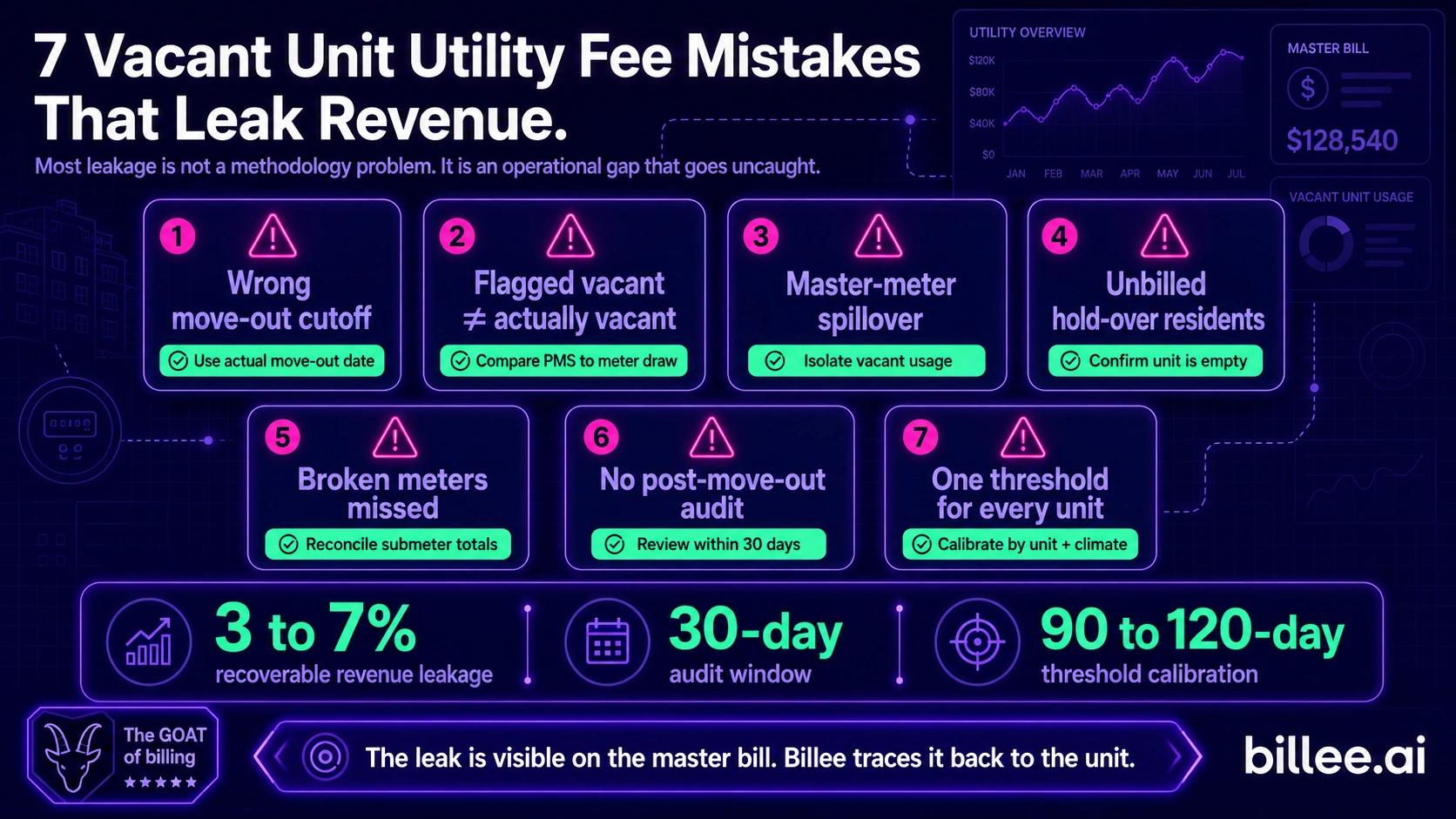
TL;DR: Most multifamily operators leak utility revenue from vacant units not because the methodology is wrong, but because seven specific operational mistakes go uncaught for months. The most expensive: stopping the meter read at the wrong move-out date, leaving the master-meter spillover unallocated, and never auditing whether vacant-flagged units are actually drawing baseline usage. Vacant units typically drain 3 to 7 percent of recoverable utility revenue from a portfolio; most of that gap is fixable.
Vacant unit utility fee mistakes fall into two categories: methodology mistakes (the operator is allocating the wrong amount in the wrong direction) and process mistakes (the methodology is sound but the operational rhythm misses charges that should have been captured). Methodology mistakes get fixed in the billing system. Process mistakes get fixed in the daily workflow between the PMS, the meter data, and the billing team.
This article walks through the seven most common mistakes and the fix for each, with internal links to the operational playbook for running Vacant Cost Recovery end-to-end.
Why this matters for multifamily operators
The math on vacant unit leakage is direct. For a 500-unit portfolio with $40 per unit per month in utility costs and a 5 percent leakage rate, the annual cost is roughly $12,000. Across a 5,000-unit portfolio, that same 5 percent is $120,000. The leakage is not theoretical, it shows up on the master meter bill every month, but most operators never trace it back to the specific vacant units responsible.
The other reason this matters now: when a property hits refinancing or disposition, the buyer's due-diligence team asks for a documented effective recovery rate. "We think we capture most of it" does not survive due diligence. Operators who run vacant unit cost recovery as a documented program get a defensible number; operators who run it ad hoc get a discount on the sale price.
The seven mistakes
1. Stopping the meter read at the lease end date instead of the actual move-out date
The lease end date is what the PMS records. The actual move-out date is when the resident handed back keys. These are often different by 1 to 14 days. Billing systems that pull the lease end date as the cutoff for the resident's final charges miss the usage between the lease end date and actual move-out, and they overcharge the next resident who moves in mid-cycle.
The fix: the move-out workflow needs to capture an actual move-out date separate from lease end. The Billee monthly billing cycle uses move-out date for final-bill calculations, not lease end. Property management staff complete a move-out checklist that includes a meter read (or a confirmation that the meter is on automated read), and that timestamp becomes the cutoff for the departing resident's allocation.
2. Treating "flagged vacant" as the same as "actually vacant"
A unit flagged vacant in the PMS does not always have zero utility draw. The refrigerator runs. The HVAC stays on vacant-unit conservation mode. Maintenance leaves a light on. None of this is a problem until usage exceeds the threshold that signals a hold-over resident, a broken meter, or an HVAC malfunction.
The mistake is treating the PMS occupancy flag as ground truth and never reconciling against meter activity. A unit can be flagged vacant in the PMS for 90 days while showing the meter activity of a two-person household, and no one notices.
The fix: every billing cycle, compare flagged-vacant units against their actual meter draw. Set a baseline (usually 30 to 50 kWh in a billing cycle for electricity, any measurable water usage) and surface any unit exceeding it as an exception. Those exceptions get investigated by a named person, not added to a dashboard queue.
3. Leaving master-meter spillover unallocated
In RUBS-billed properties, the master meter captures the property's full usage. The Common Area Deduction removes the portion attributed to non-resident usage. The remainder is allocated to occupied resident units. Vacant units do not receive a RUBS charge, which is correct.
The mistake is what happens when a master-meter bill comes in higher than expected. If the property has 95 occupied units and 5 vacant units, the 95 occupied units absorb the entire allocated amount. If the 5 vacant units are actually drawing usage (a meter is leaking, a hold-over resident is unbilled), the occupied residents are paying for it. That is a compliance risk and a resident-experience hit.
The fix: before allocating to occupied units, isolate the vacant-unit usage from the master meter total and route it to either the operating budget (if it is genuinely common-area or system leakage) or to a corrected resident charge (if it is a hold-over). The allocation to occupied residents should reflect only their share of legitimate resident-drawable usage.
For the full operational walkthrough, see How to Recover Utility Costs from Vacant Units.
4. Not billing hold-over residents
A hold-over resident is someone whose lease has ended but who has not yet moved out. The PMS may show the unit as vacant (because the lease ended), but the unit is still occupied and the meter is still running. The resident is using the property's water, electricity, and gas without being billed for it.
Hold-overs are common in tight rental markets, during eviction proceedings, and around lease renewal disputes. The financial exposure is real: a hold-over resident drawing $60 a month in water for two months is $120 the property absorbs.
The fix: the move-out workflow needs to confirm the unit is empty before flipping the PMS status. If the move-out date slips, the resident continues to be billed at the standard allocation until the actual move-out is confirmed. This sounds obvious; it is one of the most common gaps in mid-market portfolios.
5. Letting broken meters go undetected
A submeter that reads zero looks identical to a unit drawing zero baseline usage. A submeter that reads a flat number every month looks identical to a unit with consistent usage. A submeter that drops out of automated reads simply stops reporting, and the property keeps billing based on the last good read.
The mistake is treating "no anomaly" in the data as "data is correct." A broken meter produces no anomaly. It just stops sending real information.
The fix: run a monthly comparison between submeter reads and the master meter. If the sum of unit submeter reads is materially below the master meter draw (after Common Area Deduction), some unit's meter is wrong. Surface the gap, find the meter, repair or replace it. Billee runs this comparison as part of the standard monthly billing cycle.
6. Skipping the post-move-out audit window
The single highest-yield vacant cost recovery action is catching a missed or wrong move-out meter read in the first 30 days after departure. The resident is still reachable, the move-out is fresh, and the corrected charge can land on the resident's deposit reconciliation rather than getting absorbed by the property.
The mistake is moving on to the next move-out without revisiting the closed one. Operators with high turnover (student housing, build-to-rent, class C) often have the worst version of this problem because the move-out volume is high enough that the team triages forward instead of auditing backward.
The fix: the move-out workflow includes a 30-day audit step that compares the final billed amount against actual unit usage during the move-out window. If the audit surfaces a missed charge, the resident is billed before deposit reconciliation closes.
7. Using portfolio-wide thresholds that ignore unit type and climate zone
A 600 sqft studio and a 1,400 sqft three-bedroom should not have the same vacant-unit usage threshold. A property in Phoenix and a property in Minneapolis should not have the same threshold either. The HVAC load profile is different. The water usage profile is different. The vacant baseline is different.
The mistake is setting one threshold for the whole portfolio because the billing system makes it easier. The result is false positives on smaller units (treating normal baseline as a leak) and false negatives on larger units (missing a real hold-over because the threshold is set too high).
The fix: calibrate vacant-unit thresholds by unit type and climate zone. Billee's standard practice is a 90-to-120-day calibration window after go-live to set property-specific thresholds before declaring the program optimized.
How Billee can help
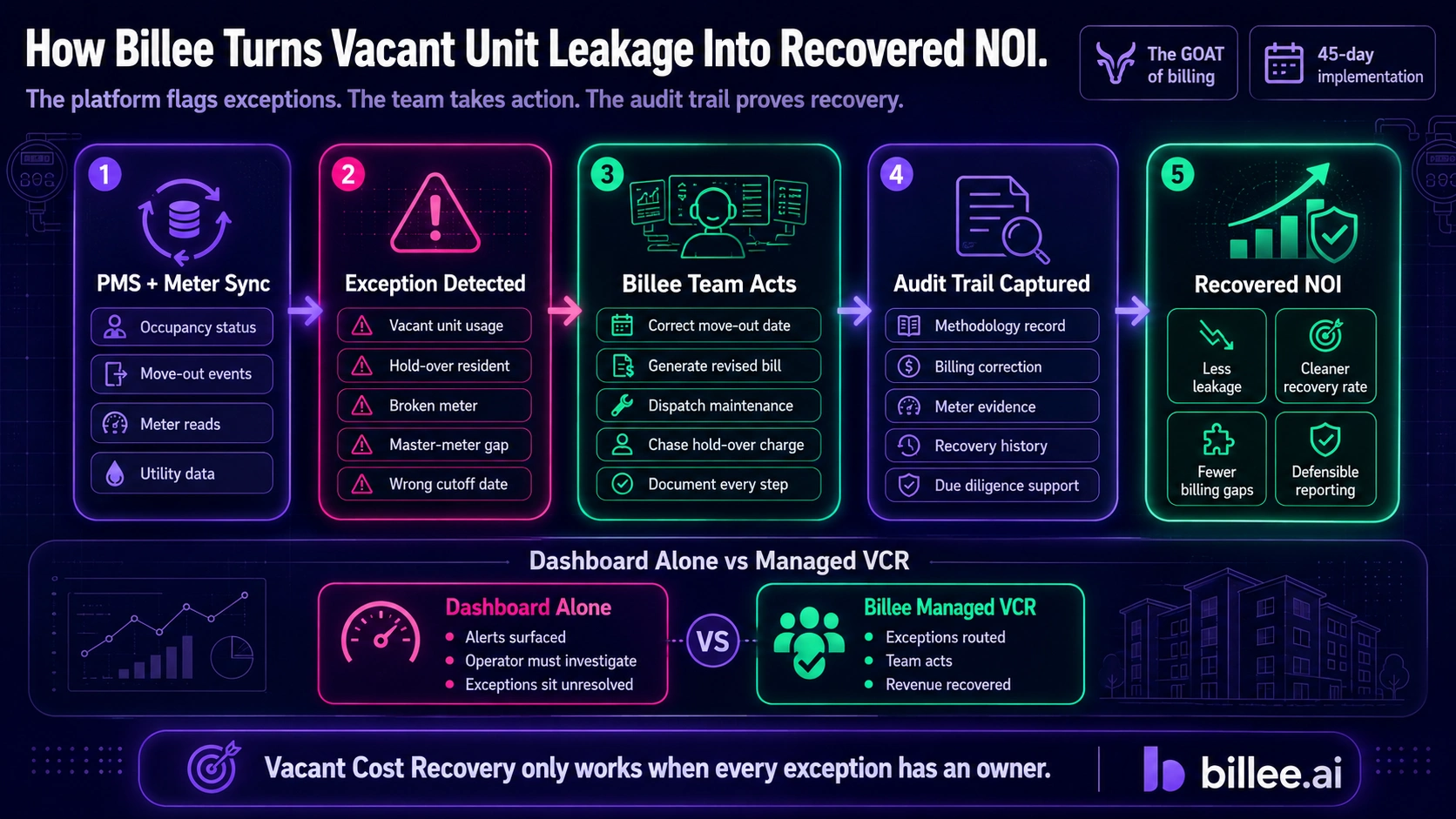
Billee operates Vacant Cost Recovery as a managed service. The platform handles occupancy and meter sync, threshold calibration, and exception generation; the dedicated Billee account team takes the corrective action on every flagged exception. The team chases the move-out correction, generates the revised bill, dispatches maintenance for hardware issues, and documents the audit trail for refinancing and disposition.
The benchmark Billee tracks on the customer dashboard is 80 to 95 percent effective recovery, per Billee's standard portfolio benchmark. Anything below 80 percent triggers a review for the seven mistakes above and any other recoverable gap. Implementation completes in 45 days, per Billee's standard implementation timeline, including PMS integration with Yardi Voyager, Yardi Breeze, RealPage, or Entrata.
FAQ
What is the biggest source of vacant unit utility fee leakage?
Missed move-out meter reads and unbilled hold-over residents account for the largest share of vacant unit leakage in most portfolios. Both are operational gaps, not methodology problems, which means both are fixable without changing the underlying RUBS or submetering setup.
How often should vacant unit thresholds be reviewed?
Vacant unit usage thresholds should be calibrated within the first 90 to 120 days after the Vacant Cost Recovery program goes live, then reviewed annually. Operators should also recalibrate after any material change in unit mix, HVAC system, or climate-zone-affecting renovation.
Can residents be billed for utility usage after their lease ends?
Yes, if the resident is still occupying the unit and the lease's utility clause permits post-term billing for actual usage. The corrected bill should land in the deposit reconciliation window. State PUC rules and lease language govern the specifics, so multi-state operators should verify the disclosure framework for each property.
Why do dashboards alone not solve this problem?
Dashboards surface exceptions. They do not take action on them. The seven mistakes above all require someone to investigate, decide on the corrective action, and execute it. Operators who rely on a dashboard alert and a property team to act on it usually capture a fraction of the recoverable amount, because the property team's primary responsibilities are leasing and maintenance, not billing forensics.
Is vacant cost recovery worth it for portfolios under 500 units?
Vacant cost recovery is worth it at any portfolio size where the math works. For a 300-unit portfolio with average utility costs of $40 per unit per month and a 5 percent leakage rate, the annual recoverable amount is roughly $7,200. The service fee for a managed VCR program needs to fit under that recovery for the program to make sense.
How long does it take to see results from fixing these mistakes?
Most operators see measurable recovery within the first full billing cycle, which is 30 to 45 days. Full optimization, including threshold calibration by unit type and climate zone, typically takes 90 to 120 days. The 90-day window is when the program transitions from "fixing acute issues" to "documented program with a stable recovery rate."
Billee runs Vacant Cost Recovery end-to-end across the portfolio. The engine flags exceptions; the team takes action; the recovered revenue lands in NOI. See how it works.
Sources
1. Simple Sub Water, "RUBS vs. Submetering: Financial Impact on NOI, Costs and Tenant Satisfaction," accessed 2026.
Insights and Industry Trends